
Mending Knitwear: Holes, Moth Damage and Worn Elbows
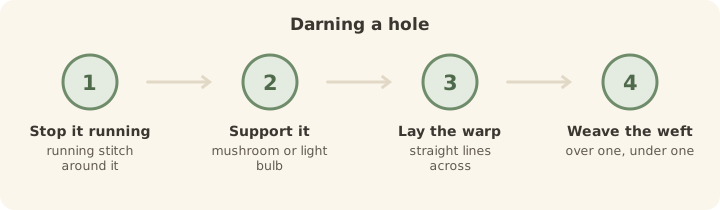
For a small hole, use duplicate stitch to rebuild the missing stitches — nearly invisible. For a larger hole, darn a woven patch across it with a darning mushroom underneath.
Secure the edges of any hole first with a running stitch, or it will grow while you work.
Repairing a hole
Stop it running
Work a line of small running stitches in fine thread all around the hole, a few stitches out from the damage. This anchors the live stitches so the hole can't grow while you handle it.
Support it from behind
Slip a darning mushroom, a light bulb or a tennis ball inside so the fabric is held in its natural curve. Darning a flat-pulled fabric gives a repair that puckers when worn.
Lay the warp threads
Stitch straight lines across the hole in one direction, anchoring well into sound fabric at both ends. Keep them evenly spaced and not too tight.
Weave the weft
Now weave at right angles, over one and under the next, alternating each row. You're making a small piece of woven cloth in the gap — which is exactly what a darn is.
Use the leftovers
The scraps from the original project are the perfect mending yarn. This is why keeping leftovers with the finished garment matters — our stash inventory sheet has a column for exactly that.
Which repair for which damage
| Damage | Repair | Result |
|---|---|---|
| Thin patch, no hole yet | Duplicate stitch over the area | Invisible reinforcement |
| Small moth hole | Duplicate stitch rebuild | Nearly undetectable |
| Larger hole | Woven darn | Visible but neat and strong |
| Worn elbow | Patch, felt or fabric | Decorative and hard-wearing |
| Stretched cuff | Thread shirring elastic through | Restored grip, invisible |
| Split seam | Re-seam with mattress stitch | As new |
Visible mending is worth considering. Rather than hiding a repair, work it deliberately in a contrasting colour — a bright darn, a decorative patch, a row of running stitches. It turns a flaw into a feature, takes the pressure off matching perfectly, and is far more forgiving for a first attempt.
Preventing the next one
Moths are drawn to body oils rather than the wool itself, so store everything clean, sealed, with cedar or lavender. Wash before putting knitwear away for the season. And reinforce elbows and heels with duplicate stitch before they wear through — five minutes on a new sweater saves an hour later.
Questions we're often asked
How do I fix a moth hole in a jumper?
Secure the edges with running stitch, then rebuild the missing stitches with duplicate stitch in matching yarn. For anything larger than a few stitches, weave a darn across the gap instead.
What is duplicate stitch?
Tracing the path of existing knitted stitches with a yarn needle, effectively knitting a new stitch on top of the old one. It's the most invisible repair for small holes and thin areas.
Can I mend a shop-bought jumper the same way?
Yes, exactly the same techniques apply. Match the yarn weight as closely as you can, and use a slightly finer yarn if in doubt — too thick makes a lumpy repair.