
Why gauge is worth the twenty minutes
Almost every disappointing finished garment comes down to the same thing: the maker skipped the swatch. It feels like a delay when you're itching to start, but a swatch is the only way to know whether your hands, your yarn and your needles together will produce the fabric the designer had in mind.
The difference is rarely dramatic per stitch and always dramatic overall. Half a stitch per inch too loose across a 40-inch jumper adds nearly four inches to the chest. That's the difference between a jumper that fits and one that gets folded away.
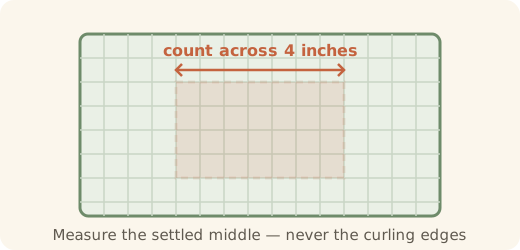
Swatch properly, not politely. Work at least six inches square so you can measure the settled middle rather than the curling edges. Wash and dry it the way you'll wash the finished piece — many yarns relax, bloom or shrink, and a swatch measured straight off the needles can tell a comfortable lie. Then measure across several places and take the average.
Reading the verdict
- Too few stitches per inch means your stitches are bigger than the pattern's. Go down a needle or hook size and swatch again.
- Too many stitches per inch means your stitches are smaller. Go up a size.
- Within about 2% is close enough for most projects. For a fitted garment, aim closer.
It feels backwards at first — smaller needle for a looser gauge — but remember you're counting stitches per inch, not stitch size. More stitches squeezed into an inch means each one is smaller.
When you can't get gauge
Sometimes no needle size gives both the right stitch count and a fabric you like. When that happens, choose the fabric — a jumper knitted at a gauge that produces stiff, unpleasant cloth will never be worn, whatever the measurements say. Then use step three above to recalculate the stitch counts for your gauge. That's not cheating; it's what experienced knitters quietly do all the time.
Row gauge matters less — until it doesn't
For most patterns you can safely ignore row gauge, because instructions usually tell you to work until a piece measures a certain length rather than for a set number of rows. Where it does matter is in shaping worked over a fixed number of rows — raglan sleeves, armhole decreases, sleeve caps — and in anything worked sideways. If your pattern shapes by row count, check the row gauge too.
Questions we're often asked
How do I measure gauge properly?
Work a swatch at least six inches square in the stitch pattern the gauge refers to, wash and dry it as you will the finished piece, lay it flat without stretching, and count the stitches across four inches in the middle. Count in two or three different places and average them — fabric is never perfectly even.
My gauge is too loose. What size needle should I use?
Go down one needle size and swatch again. As a rough guide, each needle size changes your gauge by about half a stitch per inch. If you're two full stitches per inch out over four inches, expect to move a couple of sizes.
Does gauge work the same for crochet?
Exactly the same, with hooks instead of needles. Crochet gauge is often given over a specific stitch — double crochet, half double, granny clusters — so make sure your swatch uses the stitch the pattern names, as they produce very different fabrics.
Do I really need to wash my swatch?
For anything you'll wear or wash, yes. Superwash wools in particular can grow noticeably when washed, and cotton and linen often relax. A swatch measured only off the needles has told many a knitter exactly the wrong thing.
What if my stitch gauge is right but my row gauge is off?
Usually you can carry on. Most patterns ask you to work to a measurement rather than a row count. Take care where shaping is spread over set rows — armholes, raglans and sleeve caps — and recalculate those sections using your own row gauge.