
How to measure a needle you can't identify
Most needles lose their markings eventually — the print wears off with use, double-pointed needles often arrive unmarked altogether, and inherited needle rolls rarely come with a key. What matters is the thickness of the shaft, because that's what decides the size of your stitches.
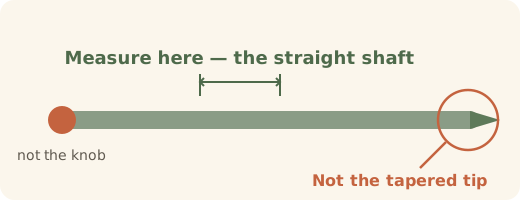
- Measure the shaft, not the tip. Needles taper towards the point, so measuring near the tip will give you a size that's too small. Use the straight middle section.
- Lay the needle flat against the screen. Hold it lightly — no need to press. If you're using the chart method, slide it down the bars until you find the one it matches exactly.
- If you're between two sizes, take the larger. Old needles can wear very slightly thinner over decades of use, and knitting a swatch will settle the question anyway.
A word about old British needles
If your needles came from a family workbasket, they may well be sized in the old UK system, where the numbers run backwards — the bigger the number, the thinner the needle. A UK 14 is a slim 2 mm, while a UK 000 is a chunky 10 mm. The chart above shows both systems side by side, so you can knit an American or modern pattern with confidence.
Does the needle material matter?
For sizing, no — a 4 mm bamboo needle is exactly as thick as a 4 mm metal one. For your knitting, it very much does: wood and bamboo grip the yarn and slow things down a little, which many knitters find kinder on the hands, while metal lets stitches fly. If your tension changes when you switch, that's the material, not the size.
Questions we're often asked
How do I know what size my knitting needles are without a gauge?
Lay the shaft of the needle against a calibrated screen like the one above, or against a ruler with clear millimetre markings. The measurement across the thickest straight part of the needle is the size. Avoid measuring near the tapered tip, which will read too small.
Are US and UK needle sizes the same?
No, and they run in opposite directions. US sizes get larger as the needle gets thicker; old UK sizes get smaller as the needle gets thicker. Millimetres are the only measurement that means the same thing everywhere, which is why modern patterns almost always give the millimetre size too.
Can I use this to size crochet hooks as well?
Yes. Measure the shaft of the hook — the straight part just below the head and above the thumb rest. The chart shows the matching letter and number sizes used for hooks alongside the knitting sizes.
My needle sits between two bars. What now?
Try the slide-to-match method for a finer reading, and check your screen zoom is at 100%. If it still falls in between, choose the larger size and knit a small swatch — the swatch will tell you far more than any gauge can.
Will this work on my phone?
Yes, beautifully — needles are small, so they fit any screen. Just make sure you've matched the card in step one on the same device you're measuring with, as every screen is different.