
What Size Are My Knitting Needles? How to Tell Without a Gauge
It happens to every knitter eventually. You reach into the workbasket for a pair of needles, and where the size used to be stamped there is now nothing at all — just smooth metal or worn bamboo. Perhaps the needles came from a friend clearing out her stash, or from a grandmother's sewing box, complete with a pattern for a cardigan and no clue what to knit it on.
The good news is that a needle's size is simply its thickness, and thickness is easy to measure. You don't need to buy anything to find out.
Measure the shaft, not the tip
This is the mistake nearly everyone makes first. Needles taper towards the point, so if you measure near the tip you'll get a reading a full size or two too small. What you want is the straight middle section of the shaft — the part that actually forms your stitches as they slide along.
The same applies to crochet hooks. Measure the smooth shaft just below the head and above the thumb rest, and ignore both the hook itself and the flattened grip.
Measure it right now
Our knitting needle sizer draws true-to-life bars on your screen once you've matched a bank card to it. Lay your needle across the bars, find the one it covers exactly, and you'll have the size in millimetres, US and UK — plus which crochet hook matches and which yarn it suits.
The three sizing systems, and why they disagree
Part of the confusion is that the knitting world never settled on one way of naming needles.
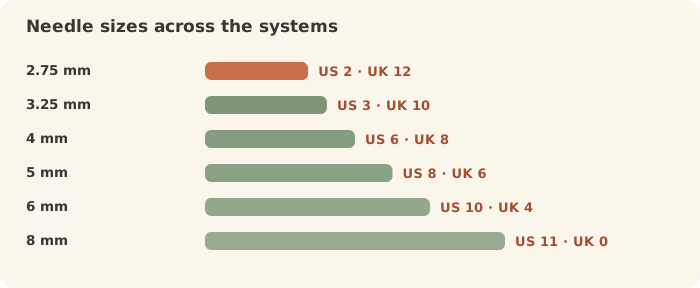
- Millimetres are the actual measurement, used everywhere in modern patterns. A 4 mm needle is four millimetres thick, and that means the same thing in every country.
- US sizes count upwards as needles get thicker: US 6 is 4 mm, US 8 is 5 mm, US 11 is 8 mm.
- Old UK and Canadian sizes count backwards. The bigger the number, the thinner the needle. A UK 14 is a slender 2 mm, while a UK 000 is a chunky 10 mm.
This is why a pattern calling for "size 8 needles" can mean two entirely different things depending on where it was published. A US size 8 is 5 mm; an old UK size 8 is 4 mm. When in doubt, trust the millimetres — and if a vintage pattern gives only a number, look for the country of publication before you cast on.
What if my needle falls between two sizes?
Old needles do wear very slightly with decades of use, and some brands run a hair over or under. If your measurement sits between two sizes, take the larger one and knit a small swatch. The swatch will tell you more than any gauge tool can, because what actually matters is not the needle's size but the fabric it produces with your yarn and your hands.
Does the material change the size?
Not the size, but very much the experience. A 4 mm bamboo needle is exactly as thick as a 4 mm metal one, yet the two knit quite differently. Bamboo and wood grip the yarn gently, which slows things down and helps stitches stay put — many knitters find them kinder on the hands and easier with slippery yarns. Metal lets stitches fly along and suits anyone who likes to knit at speed. If your tension suddenly changes when you switch needles, the material is usually the culprit, not the size.
Sorting out an inherited needle collection
If you've come into a whole roll of unmarked needles, work through them in one sitting: measure each pair, then label them. A dab of nail varnish in a colour code, a paper tag tied on with yarn, or a permanent marker on the flat end all work well. An hour spent doing this will save you many small frustrations later, and it's a rather lovely way to spend an afternoon with a cup of tea.
While you're at it, do the same for the yarn. If you've inherited needles you have almost certainly inherited unlabelled balls too — our mystery yarn identifier will tell you what weight each one is, and which of your newly-labelled needles it wants.