
Lace Knitting: Lifelines, Charts and Reading Your Knitting
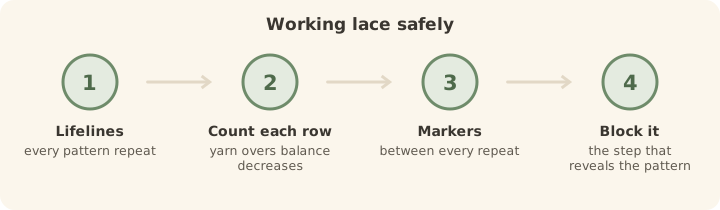
Put in a lifeline every repeat — a length of smooth waste yarn threaded through all live stitches. Then a mistake means ripping back to a safe row with every stitch held, rather than starting again.
Count your stitches at the end of every pattern row. Lace is self-checking if you use it: a yarn over always pairs with a decrease.
Lace has a reputation for difficulty that it only half deserves. The stitches themselves are simple — yarn overs and decreases. What makes lace demanding is that a single missed yarn over shifts everything after it, and the error is invisible until several rows later.
The habits that make lace easy
Lifelines, without exception
Thread smooth waste yarn through every stitch on the needle at the end of each pattern repeat. Interchangeable needles often have a small hole at the join, which lets you lay a lifeline as you knit the row.
Count at the end of every row
Yarn overs add a stitch and decreases remove one, and in most lace they balance exactly. If the count is right, the row is right. If it isn't, the mistake is in that row, where it's easy to find.
Use markers between repeats
Place a marker at every pattern repeat. Then an error is contained to the section between two markers — you check ten stitches rather than a hundred and twenty.
Learn to read your knitting
A yarn over sits as a visible hole with a straight strand across it. Decreases lean left or right. After a few rows you can compare your fabric with the chart directly rather than counting rows.
Lace changes size dramatically when blocked
Unblocked lace looks like a crumpled rag; blocked, it can grow by 30% and open completely. Swatch and block before trusting any measurement — our gauge calculator will tell you what your blocked fabric actually does.
Charts versus written instructions
Most lace is charted, and charts are genuinely easier once you adjust — the symbols form a picture of the fabric, so you can see the motif emerging. Read right to left on right-side rows and left to right on wrong-side rows when working flat.
Many lace patterns have plain purl rows on the wrong side, which means half your rows need no thinking at all. That's often where people put their lifelines.
Blocking is not optional in lace. It is the step that transforms the work — pins or blocking wires stretch every hole open and set the shape. A lace shawl straight off the needles genuinely looks like a failure, and half an hour of blocking turns it into the thing you imagined.
Choosing yarn for lace
Smooth yarns with good stitch definition show the pattern; fluffy mohair blurs it, though a mohair halo is beautiful in its own way. Wool blocks best and holds the opened shape. Silk and bamboo drape gloriously but can stretch and stay stretched, so block them gently.
Questions we're often asked
What is a lifeline in lace knitting?
Smooth waste yarn threaded through every live stitch at a known point. If you make a mistake, you rip back only to the lifeline and all the stitches are held safely, right way round.
How do I fix a missed yarn over?
If it's on the row you're working, pick up the strand between the stitches and place it on the needle. If it's a row or two down, drop the stitches above it, create the yarn over and work them back up with a crochet hook.
Why does my lace look nothing like the picture?
Because it hasn't been blocked. Unblocked lace is bunched and closed. Pinning it out wet opens every hole and reveals the pattern — the difference is dramatic.