
Blocking: The Step That Makes Handmade Look Finished
There is a moment familiar to every knitter and crocheter: the piece is finished, and it looks — well — homemade. The edges curl, the lace is a crumpled mess, the granny squares are cheerfully different sizes. Blocking is what turns that into something you'd happily give away.
What blocking actually does
Wet fibres relax and then dry in whatever shape you leave them. That's the whole principle. Wool has a memory it can be persuaded to forget and re-learn, which is why blocking works dramatically on wool, moderately on cotton and barely at all on acrylic.
The results can be startling. Lace opens from a shrivelled rag into something delicate. Stocking stitch stops curling at the edges. Squares that measured anywhere between five and seven inches become the same size, which makes joining a blanket infinitely less maddening.
Measure before you block, and after
Blocking changes measurements, sometimes considerably. Our gauge calculator lets you check a swatch before and after so you know what your fabric really does — and our blanket planner works from the blocked square size, which is the one that counts.
Three ways to do it
Wet blocking
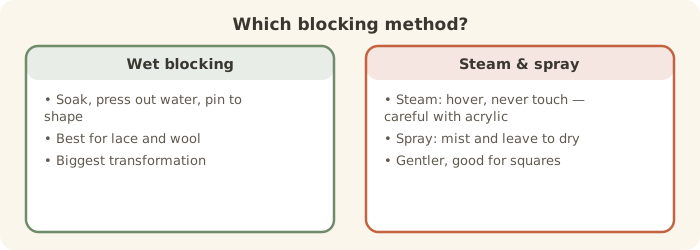
The most thorough. Soak the piece in cool water with a little wool wash for fifteen minutes, lift it out supporting its weight so it doesn't stretch, press the water out between towels — never wring — then lay it flat and pin it to shape. Best for lace and anything that needs real persuasion.
Steam blocking
Pin the piece to shape dry, then hover a steam iron just above it, never touching. Quick, and good for flattening edges. Take care with acrylic: too much heat "kills" it, leaving it permanently limp and shiny. That is occasionally a deliberate effect, but rarely one you want by accident.
Spray blocking
Pin it out and mist thoroughly with a spray bottle until damp, then leave to dry. Gentler than wet blocking and quite enough for most everyday projects and squares.
You don't need special equipment. A clean towel on a spare bed works perfectly well. Foam mats and rustproof pins make things easier and let you use a windowsill or the floor, but generations of beautiful knitting was blocked on a towel. Do use rustproof pins — ordinary ones leave brown marks that don't wash out.
Which fibres respond
- Wool and other animal fibres — block beautifully and hold the new shape well.
- Superwash wool — blocks readily but can grow. Measure carefully and don't over-stretch.
- Cotton and linen — respond moderately. Linen improves enormously with washing and wear.
- Acrylic — barely responds to wet blocking. Steam gives some effect, with the caution above.
- Silk and bamboo — block well but can stretch and stay stretched, so be gentle.
Blocking a swatch is not optional
If you plan to block the finished piece, block the swatch too — otherwise you're measuring a fabric that no longer exists. Superwash wools in particular can grow by an inch over four after a soak, which across a jumper front is the difference between fitting and not.
Squares, and why they matter most
Blocking is at its most useful with granny squares and motifs. Corners square up, edges straighten, and every square becomes the same size — which turns joining from a fight into a pleasure and makes the finished blanket lie flat rather than ripple. Block a batch at a time on a towel while you make the next batch.