
Stitch Markers, Row Counters and Other Small Rescues
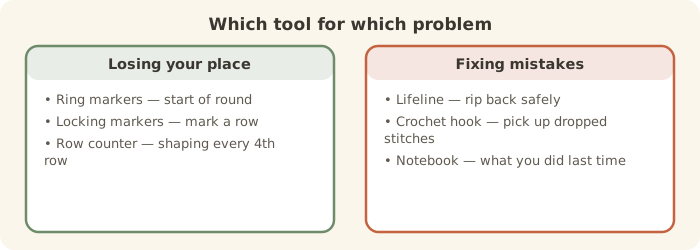
Nothing on this list costs much, and each one prevents a specific, common, aggravating problem. If you find yourself recounting rows or discovering errors twenty rows late, one of these is the answer.
Stitch markers
Two kinds, and you want both.
Ring markers slip onto the needle and sit between stitches, marking the start of a round or the position of shaping. Locking markers clip into the fabric itself, marking a row you'll need to find later or holding a dropped stitch safely until you can fix it.
The best use is one most people miss: before working a row with shaping spread across it, place a marker at every point where a change happens. Then work the row without counting at all — just do the increase or decrease when you reach a marker.
Where do the markers go?
Our increase and decrease calculator works out the spacing for you and writes it as a plain instruction, so you know exactly where to place each marker before you start the row.
Row counters
A clicker, a ring counter on the needle, or a phone app. Any of them beats memory, and all of them beat counting rows in a textured fabric where the rows are hard to see. Essential for shaping worked every fourth or fifth row, and for keeping two sleeves identical.
Lifelines
Not a tool but a habit: a length of smooth contrasting yarn threaded through all live stitches every twenty rows, especially in lace. If you have to rip back, you rip to the lifeline and every stitch is held, right way round. Two minutes of work that has saved thousands of projects.
Interchangeable needle sets often have a small hole at the join — thread waste yarn through it and knit a row, and you've laid a lifeline without doing anything extra at all.
A blunt yarn needle
For weaving in ends, grafting and seaming. Blunt so it slides between plies rather than splitting them. A bent-tip version makes weaving noticeably quicker, which matters enormously on a blanket with two hundred ends.
Small scissors, and a tape measure
Keep scissors for yarn only. Buy a retractable tape marked in both inches and centimetres, because patterns never agree on which to use — and keep it in the project bag rather than in a drawer, or you'll guess instead of measuring.
A notebook
The least glamorous and most useful item here. Write down the needle size, the yarn, the modifications and where you stopped. Coming back to a project after three weeks is an entirely different experience with notes than without.
Questions we're often asked
What is the difference between ring and locking stitch markers?
Ring markers sit on the needle between stitches to mark a position in the row or round. Locking markers clip into the fabric to mark a specific row, or to hold a dropped stitch safely.
Can I use something instead of stitch markers?
Yes — a loop of contrasting yarn, a paperclip, or a small safety pin all work. Just avoid anything with a rough edge that could snag your yarn.
What is a lifeline and when should I use one?
Waste yarn threaded through all live stitches at a known point. Use one every twenty rows in lace or any complex pattern, so a mistake means ripping back to a safe row rather than starting again.