
How to Read a Knitting Pattern Without Panicking
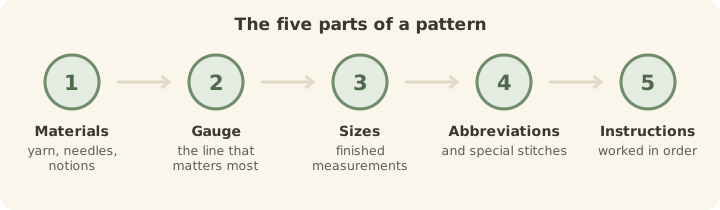
A knitting pattern looks like code until you know its shape. Every one, from a free scarf to a book of jumpers, has the same five parts in the same order — and once you can see them, the rest becomes ordinary reading.
1. The materials list
Yarn, needle size, notions and gauge. Read this before you buy anything. The yarn will be given as a brand plus a quantity, and the quantity is what matters — if you're using something else, convert by total yardage rather than ball count.
2. The gauge statement
Usually one line, and easily the most important in the pattern: something like "22 sts and 30 rows to 4 inches in stocking stitch". Everything else assumes you match it. If you don't, the finished piece will be a different size than the numbers promise.
Check yours in a minute
Our gauge calculator compares your swatch to the pattern, tells you which way to change needles, and will convert every stitch count to your own gauge if you'd rather work with what you have.
3. The size chart
Finished measurements, not body measurements. A jumper listed as 38 inches means the garment is 38 inches around — which for a 36 inch chest gives two inches of ease. Choose by the finished measurement you want, not by dress size.
4. The abbreviations and any special stitches
Read this section even if you're experienced, because designers vary. If a pattern uses an unusual cast-on or a stitch you don't know, that's far better discovered now than at the moment your hands are full of yarn.
5. The instructions
Two conventions do most of the confusing:
- Brackets and asterisks mark repeats. "[K2, p2] 6 times" means work the bracketed pair six times over. "*K3, k2tog; rep from *" means repeat that sequence to the end of the row.
- Sizes in brackets run smallest first: "cast on 88 (96, 104, 112)". Go through the whole pattern with a highlighter and mark your size everywhere before you begin. Five minutes now saves an unpicked sleeve later.
Stitch counts in brackets at the end of a row are a gift. When you see "(72 sts)", stop and count. Finding a mistake at the end of a row costs a minute; finding it twenty rows later costs an evening.
What to do before casting on
Read the entire pattern through once, even the parts you don't understand yet. You're looking for surprises: a technique you've never done, a piece worked in an unexpected direction, or an instruction to "at the same time" do two things at once, which is where most people come unstuck.
Questions we're often asked
What does "work as established" mean?
Carry on in whatever pattern you've been working — the same stitch pattern, the same shaping rhythm — without further instruction. It's the designer's way of avoiding repeating twenty identical rows.
What is ease in a knitting pattern?
The difference between the garment's measurement and the body's. Positive ease means roomier than the body, negative ease means it stretches to fit. Most jumpers use 2 to 4 inches of positive ease; hats use negative.
Do I have to match the row gauge too?
Usually not, since most patterns tell you to work to a measurement. It matters where shaping is spread over a set number of rows, such as raglans, armholes and sleeve caps.