
Stranded Colourwork: Floats, Tension and Reading Charts
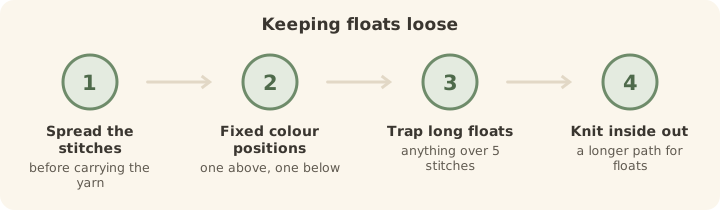
Puckering is nearly always floats carried too tightly across the back. Spread the stitches on your right needle before carrying the yarn across, so the float has to reach a stretched distance rather than a bunched one.
Trap any float longer than 5 stitches, and keep the same colour in the same hand throughout for consistent tension.
Stranded colourwork — Fair Isle and its relations — produces some of the most beautiful knitted fabric there is, and it goes wrong in exactly one way: the fabric draws in and puckers. Everything below is about preventing that.
Getting floats right
Spread before you carry
Before taking the unused colour across the back, push the stitches you've just worked apart along the right needle. The float then has to span a stretched fabric, which guarantees it's long enough.
Keep colours in fixed positions
Whichever method you use, always carry the background colour on one side and the pattern colour on the other. Swapping mid-row changes which colour sits proud and shows as a visible inconsistency.
Trap long floats
Anything over about five stitches will catch on fingers and rings. Twist the carried yarn around the working yarn once, halfway across, to tack it down.
Work inside out if you can
When knitting in the round, turning the work inside out means the floats travel around the outside of the tube — a longer path, which naturally makes them looser. A simple trick with a large effect.
Colourwork changes your gauge
Stranded fabric is thicker and usually tighter than plain stocking stitch. Swatch in the colourwork pattern itself and check it with our gauge calculator — using a plain-stitch gauge will give you a garment that's too small.
Reading a colourwork chart
Each square is a stitch, each row of squares a round. Charts for knitting in the round are read right to left on every row, because you're always working in the same direction. Charts for flat knitting alternate: right to left on right-side rows, left to right on wrong-side rows.
Most colourwork motifs repeat over a set number of stitches, marked on the chart with a bracket. Your cast-on must be a multiple of that repeat — which is worth checking before you start, not after twenty rounds.
Choose colours by value, not by hue. A pattern only shows up if the two colours differ in lightness. Two beautiful shades of similar value produce a fabric where the motif simply disappears. Photograph your yarns together in black and white before committing — it's the quickest test there is.
Steeks, briefly
Traditional Fair Isle is knitted as a tube and then cut open, which sounds alarming and works because wool grips itself. The cut edge is reinforced first, either by crochet or machine stitching. If you're going to try it, use a sticky non-superwash wool — superwash and slippery blends do not hold, and that is when steeking goes badly.
Questions we're often asked
Why does my colourwork pucker?
The floats across the back are too tight. Spread the stitches on your right needle before carrying the yarn across, so the float spans the fabric at full stretch rather than bunched.
How long can a float be before I trap it?
About five stitches. Longer than that and fingers or jewellery catch in them, so twist the carried yarn around the working yarn once in the middle of the run.
Do I need a different needle size for colourwork?
Often yes — most knitters work stranded fabric more tightly than plain, so going up a size is common. Swatch in the colourwork pattern to find out rather than assuming.