
Melt and Pour Soap: A Safe Way to Start
Melt-and-pour soap base is already saponified, so there is no lye handling and no curing time. Melt it, add fragrance and colour at around 60°C, pour, and it's ready to use in a few hours.
Use about 3% fragrance by weight, and spritz the surface with rubbing alcohol after pouring to remove bubbles.
Cold process soap making — mixing lye with oils — makes wonderful soap and requires genuine care with a caustic chemical. Melt and pour skips all of that, which makes it the sensible place to start and a lovely craft in its own right.
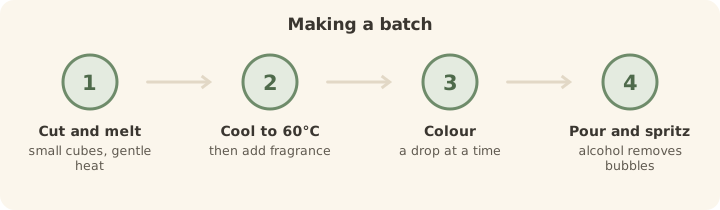
Making a batch
Cut and melt the base
Chop the base into small cubes so it melts evenly. Use a double boiler or short bursts in a microwave, stirring between each. Do not let it boil — overheated base becomes rubbery and loses clarity.
Cool a little, then add fragrance
Let it drop to around 60°C before adding fragrance oil, or the scent simply evaporates. Around 3% by weight is standard — 15 g of fragrance for 500 g of base.
Colour gently
Add colourant a drop at a time and stir well. Melt and pour takes colour readily, and it is far easier to deepen a shade than to lighten one.
Pour and spritz
Pour into moulds, then spray the surface with rubbing alcohol. The bubbles vanish instantly, leaving a clean top. Leave to set for two to three hours before unmoulding.
Working out quantities
Soap moulds are measured in volume, like candle jars. Our candle wax calculator converts container dimensions to volume, which gets you close for soap too — soap base is roughly 1 g per ml.
Which base to buy
| Base | Character | Best for |
|---|---|---|
| Clear glycerin | Transparent, shows colour vividly | Embeds, layers, jewel colours |
| White | Opaque, gives soft pastels | Gentle colours, swirls |
| Shea or cocoa butter | Creamy, more moisturising | Dry skin, gift soaps |
| Goat's milk | Mild and creamy | Sensitive skin |
| Oatmeal | Gently exfoliating | Rustic, textured bars |
Wrap the bars as soon as they're set. Melt and pour attracts moisture from the air — leave a bar out and it develops beads of "glycerin dew" on the surface. Cling film or shrink wrap solves it entirely.
Things to avoid
Fresh food such as fruit or milk will rot in a soap bar; use dried botanicals or proper cosmetic additives instead. Candle fragrance oils are not always skin-safe, so buy fragrance specifically sold for soap. And don't add water to thin the base — it prevents proper setting.
Questions we're often asked
Do I need to cure melt and pour soap?
No. The base is already saponified, so bars are usable as soon as they're firm — a few hours. Cold process soap is what needs four to six weeks of curing.
How much fragrance do I add to soap?
About 3% by weight, so roughly 15 g per 500 g of base. Add it at around 60°C — any hotter and much of the scent evaporates before it sets.
Why is my soap sweating?
Glycerin draws moisture from the air. Wrap the bars in cling film or shrink wrap as soon as they're set, and store them somewhere dry.