
Casting Off: Why Your Edge Is Too Tight, and How to Fix It
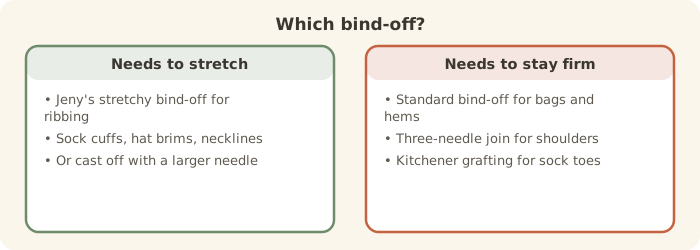
The most common finishing complaint in knitting is a cast-off edge that won't stretch — a hat that grips the forehead, a sock cuff that has to be forced over the heel, a neckline that won't go over a head. It's almost always the bind-off, and it's easily fixed.
The standard cast-off
Knit two, pass the first over the second, repeat. Neat, quick and firm — which is exactly right for a shoulder seam or the top of a bag, and exactly wrong for anything that must stretch.
The simplest improvement, if you use nothing else from this article: cast off with a needle two or three sizes larger. It costs nothing, takes no extra time, and solves the majority of tight edges.
Stretchy cast-off for ribbing
Jeny's surprisingly stretchy bind-off adds a yarn over before each stitch, which builds slack into the edge. It's the standard recommendation for sock cuffs, hat brims and toe-up socks, where the edge has to stretch over a heel or a head and then recover.
Working out where to stop
Bind off at the right length rather than the right row count. Our gauge calculator converts between rows and inches so you know when you've reached the measurement the pattern wants.
Three-needle cast-off
Joins two sets of live stitches while binding off, producing a firm seam in one step. Ideal for shoulder seams, where you actually want no stretch — a shoulder that gives will let the whole garment sag over time.
Kitchener stitch (grafting)
Not a cast-off at all, but a way of joining two sets of live stitches invisibly with a yarn needle. Used at sock toes, where any ridge would be felt underfoot for the life of the sock. Fiddly, worth learning, and considerably easier if you say the four-step rhythm aloud as you work.
Test before you commit. Cast off a few inches, then stretch that section over whatever it has to fit — the head, the heel, the hand. If it resists, undo it and try again with a larger needle or a stretchier method. Far quicker than discovering the problem when the piece is finished and the ends are woven in.
Matching the two ends
A stretchy cast-on paired with a firm cast-off gives a piece with a noticeably different top and bottom. For anything where both edges show — a scarf, a cowl, a ribbed hat — use methods that match, and the finished item will look deliberate rather than accidental.
Questions we're often asked
Why is my cast-off edge so tight?
Almost always because the bind-off has less give than the fabric below it. The quickest fix is casting off with a needle two or three sizes larger than you knitted with.
What is the stretchiest bind-off?
Jeny's surprisingly stretchy bind-off, which adds a yarn over before each stitch. It's the usual choice for sock cuffs and hat brims.
When should I use a three-needle cast-off?
For shoulder seams and anywhere you want a firm, stable join with no stretch. It binds off and seams two sets of live stitches at the same time.